I’ve now opened a digital gallery as a direct source for collectors to acquire one-of-a-kind works at shop.christopheradams.io.
The first set of photographs for sale are among those exhibited at my solo show Island of Another Scene (May–August 2025, Taipei), where The Studio’s Cesar Reyes and Jessica Lin nudged me to put a price on my images. The new shop will host these works and make more available in the future.
The business of selling photographs is a commercial calculus of edition sizes, paper stock, framing materials, and logistics costs. I’ve simplified the equation by producing just one edition of each work in a physical and digital format.
I gleaned the spirit and mechanics of making works unique from the practice of German photographer Wolfgang Tillmans. He customarily exhibits his photographs as unframed prints, while collectible works are offered as an edition of one (plus one artist’s proof), accompanied by a signed certificate of authenticity, a small color print, and a CD that stores the high-resolution image. The collector agrees to retain a single exhibition print of the work, while the artist is also free to make and exhibit one copy. A print may even be destroyed and re-produced as circumstances and technologies change.1 This pact between the image-maker and image-owner sustains the work’s value, while the color match print and digital image file conserve its quality.
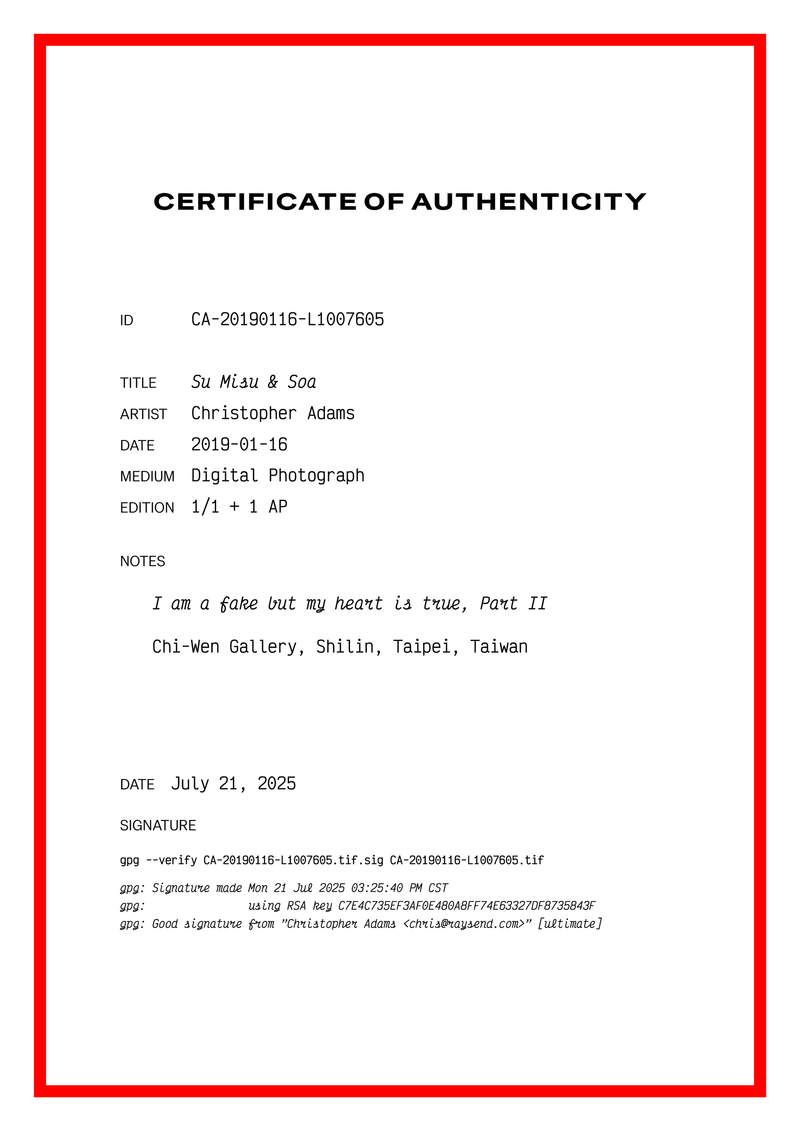
A certificate of authenticity for Su Misu & Soa (2019)
I’ve adapted Tillmans’s practice by first discarding the compact disc, and then signing the photograph cryptographically.2 Each work includes a digital image and signature file, a certificate of authenticity, and an 8×10 archival inkjet print.
An initial set of ten works are listed in the digital gallery. Additional works from the Collection are available for production upon request. Please email [email protected] for any inquiries.
-
Marchesi, Monica (2021). “Reprint and destroy? Wolfgang Tillmans’ artistic practice: The reprinting and the intentional destruction of large-format inkjet prints.” In Transcending Boundaries: Integrated Approaches to Conservation, ICOM-CC 19th Triennial Conference Preprints, Beijing, 17–21 May 2021. Beijing: ICOM-CC. ISBN 978-2-491997-14-4. ↵
-
You might ask, why not use a blockchain for this? An NFT can correlate a work’s ownership, data, and image. However, I’m observing an older convention, where the artist–collector bond is more privy than a smart contract, and the images aren’t broadcast to every odd marketplace. In short, these works are not just tokens. ↵
Link: shop.christopheradams.io
Filed under: Notes Featured Newsletter Photography